Read this article in: 繁體中文 · 简体中文
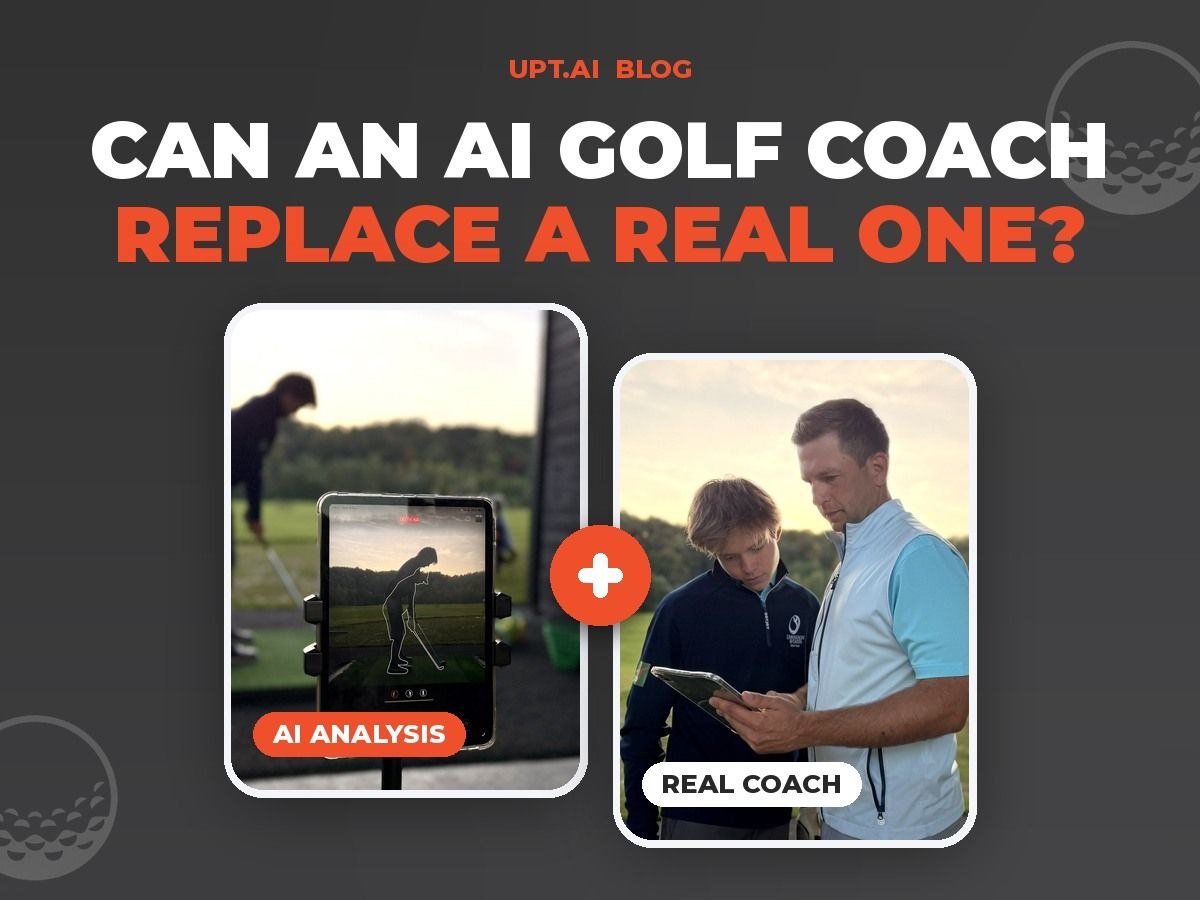
A few years ago, getting a proper look at your swing meant booking a lesson, standing in front of a launch monitor and hoping the hour was enough. Today a phone on a tripod can capture your swing at 240 frames per second, and an AI model can break it into positions, score it and flag the faults in less time than it takes to tee up the next ball.
So it is a fair question: if software can see your swing that clearly, why pay a coach at all? We build an AI golf coaching app, so you might expect us to say AI is all you need. We think the honest answer is more useful — and it is the reason UpT combines both.
What AI swing analysis does well
It never gets tired and never guesses. An AI model measures every swing against the same criteria. Swing number 80 of a range session gets exactly the same attention as swing number one. That consistency is hard for any human eye to match.
It sees what the eye misses. At full speed, a downswing lasts a fraction of a second. Frame-by-frame analysis catches the small shifts — a head that moves off the ball, hips that stall, a club that drifts off plane at the top — that are almost invisible in real time.
It is there when you practise. Most improvement happens between lessons, alone on the range or in a simulator bay. AI feedback turns those sessions from “hitting balls” into deliberate practice, because you find out straight away whether the change you are working on is actually happening.
It keeps score over time. A swing score that you can track week by week shows whether you are really improving or just having a good day. That is motivating — and it gives your coach real data instead of “it felt better on Tuesday.”
Where AI falls short
It doesn’t know what to fix first. This is the big one. A swing analysis might flag three or four issues at once. But faults are connected: an early extension may be a reaction to a poor setup, and an over-the-top move may be compensation for a closed clubface. Fix the symptom and the cause just finds another way out. Deciding which domino to push first is still a coach’s skill.
It doesn’t know you. Your flexibility, an old back injury, how many hours a week you can practise, whether you want to break 100 or win the club championship — all of this changes what a “correct” swing looks like for you. Good coaching is built around the player, not around a model of an ideal swing.
It can tell you what is wrong, not how it should feel. Knowing your hips are stalling is not the same as fixing it. Coaches spend years collecting cues and drills, and learning which one works for which player. That translation from data to feel is where most lessons actually pay off.
It only sees what the camera sees. A bad angle, poor light or a phone balanced on a golf bag can mislead any analysis. AI is only as good as the video you give it.
It doesn’t keep you accountable. Someone who expects to see your next swing is a powerful reason to keep doing the drills. An app notification is not quite the same.
The better question: how do you combine them?
Instead of “AI or coach”, think of a loop where each does the part it is best at:
In practice, that exchange can be very short. A golfer notices the app keeps flagging inconsistent backswings and asks their coach about it. The coach sees in the video that the player is losing structure at the top and sends a single drill. A week later the AI numbers confirm the change is holding, and the coach moves the player on to the lower body. Each message takes a minute; the progress is real.
The result: you get expert judgement where it matters, and you stop paying for an hour of lesson time to hear things a camera could have told you.
Which balance is right for you?
Beginners benefit most from a coach early on — to build a sound grip, setup and basic motion — with AI as a way to make sure practice doesn’t drift between lessons.
Regular club golfers can lean on AI for day-to-day feedback and bring in a coach for targeted reviews when a fault won’t go away or when they want to make a bigger change.
Competitive players usually already work with a coach. For them, AI is mostly about data: objective tracking, more swings reviewed, and remote check-ins during travel and tournaments.
A note for coaches
AI doesn’t make coaches unnecessary — it makes their time more valuable. When software handles the repetitive markup and measurement, a coach can review more swings, support students between lessons and work with players who live in another city or another country. The coaches who will do best are the ones who use AI as an assistant, not the ones who compete with it.
How UpT brings both together
UpT was designed around exactly this loop, so you don’t have to choose:
Ready to try the loop? Download UpT, film your first swing and get your AI swing score in seconds. When you want a second opinion, a real coach is one tap away.
A few years ago, getting a proper look at your swing meant booking a lesson, standing in front of a launch monitor and hoping the hour was enough. Today a phone on a tripod can capture your swing at 240 frames per second, and an AI model can break it into positions, score it and flag the faults in less time than it takes to tee up the next ball.
So it is a fair question: if software can see your swing that clearly, why pay a coach at all? We build an AI golf coaching app, so you might expect us to say AI is all you need. We think the honest answer is more useful — and it is the reason UpT combines both.
What AI swing analysis does well
It never gets tired and never guesses. An AI model measures every swing against the same criteria. Swing number 80 of a range session gets exactly the same attention as swing number one. That consistency is hard for any human eye to match.
It sees what the eye misses. At full speed, a downswing lasts a fraction of a second. Frame-by-frame analysis catches the small shifts — a head that moves off the ball, hips that stall, a club that drifts off plane at the top — that are almost invisible in real time.
It is there when you practise. Most improvement happens between lessons, alone on the range or in a simulator bay. AI feedback turns those sessions from “hitting balls” into deliberate practice, because you find out straight away whether the change you are working on is actually happening.
It keeps score over time. A swing score that you can track week by week shows whether you are really improving or just having a good day. That is motivating — and it gives your coach real data instead of “it felt better on Tuesday.”
Where AI falls short
It doesn’t know what to fix first. This is the big one. A swing analysis might flag three or four issues at once. But faults are connected: an early extension may be a reaction to a poor setup, and an over-the-top move may be compensation for a closed clubface. Fix the symptom and the cause just finds another way out. Deciding which domino to push first is still a coach’s skill.
It doesn’t know you. Your flexibility, an old back injury, how many hours a week you can practise, whether you want to break 100 or win the club championship — all of this changes what a “correct” swing looks like for you. Good coaching is built around the player, not around a model of an ideal swing.
It can tell you what is wrong, not how it should feel. Knowing your hips are stalling is not the same as fixing it. Coaches spend years collecting cues and drills, and learning which one works for which player. That translation from data to feel is where most lessons actually pay off.
It only sees what the camera sees. A bad angle, poor light or a phone balanced on a golf bag can mislead any analysis. AI is only as good as the video you give it.
It doesn’t keep you accountable. Someone who expects to see your next swing is a powerful reason to keep doing the drills. An app notification is not quite the same.
The better question: how do you combine them?
Instead of “AI or coach”, think of a loop where each does the part it is best at:
- Film. Record your swing from a consistent angle — down-the-line or face-on.
- AI first pass. Get an instant swing score and a list of the key faults, broken down by swing position.
- Coach decides. Send the swing and the AI report to your coach. They tell you which issue matters most right now and give you one drill for it.
- Practise with feedback. Work on that drill and use AI analysis between sessions to check you are actually changing the movement.
- Track and repeat. Watch your score trend, then go back to your coach when you plateau or are ready for the next step.
In practice, that exchange can be very short. A golfer notices the app keeps flagging inconsistent backswings and asks their coach about it. The coach sees in the video that the player is losing structure at the top and sends a single drill. A week later the AI numbers confirm the change is holding, and the coach moves the player on to the lower body. Each message takes a minute; the progress is real.
The result: you get expert judgement where it matters, and you stop paying for an hour of lesson time to hear things a camera could have told you.
Which balance is right for you?
Beginners benefit most from a coach early on — to build a sound grip, setup and basic motion — with AI as a way to make sure practice doesn’t drift between lessons.
Regular club golfers can lean on AI for day-to-day feedback and bring in a coach for targeted reviews when a fault won’t go away or when they want to make a bigger change.
Competitive players usually already work with a coach. For them, AI is mostly about data: objective tracking, more swings reviewed, and remote check-ins during travel and tournaments.
A note for coaches
AI doesn’t make coaches unnecessary — it makes their time more valuable. When software handles the repetitive markup and measurement, a coach can review more swings, support students between lessons and work with players who live in another city or another country. The coaches who will do best are the ones who use AI as an assistant, not the ones who compete with it.
How UpT brings both together
UpT was designed around exactly this loop, so you don’t have to choose:
- AI swing analysis: film at up to 240 fps and get a swing score, the key faults, and a position-by-position breakdown.
- Compare with a pro: put your swing side by side with, or overlaid on, a reference swing.
- Real, verified coaches: send your swing for a personal review and get feedback in text or voice, plus drills to work on.
- Progress tracking: see how your score changes over weeks and months.
- And if you are a coach, your account is free — bring your students in and use AI to support them between lessons.
Ready to try the loop? Download UpT, film your first swing and get your AI swing score in seconds. When you want a second opinion, a real coach is one tap away.
